


You are using an out of date browser. It may not display this or other websites correctly.
You should upgrade or use an alternative browser.
You should upgrade or use an alternative browser.
The Communication Cube
- Thread starter Jourdy288
- Start date

TeDaDeS
Forum Addict!
- Joined
- Jan 15, 2004
- Messages
- 3,082
Not really related, but it reminds me of my (old) TI watch: https://www.mouser.ca/ProductDetail/Texas-Instruments/EZ430-CHRONOS-915Found out about this recently, the GPS feature is what interests me the most.
TeDaDeS
Forum Addict!
- Joined
- Jan 15, 2004
- Messages
- 3,082
Probably a common thing to be suppressed, but did you hear anything about the impact of Typhoon Bavi on China?
- Shenyang (Liaoning Province): The provincial capital was hit by record-breaking rainfall.
- Chengde & Kuancheng County (Hebei Province): Continuous torrential rain caused water levels on neighborhood roads to rise more than 2 meters.
- Beijing: The capital's suburban districts (specifically Miyun and Huairou) suffered flash floods that destroyed roads, cut power to dozens of villages.
- Taizhou (Zhejiang Province): Typhoon Bavi hit this city first, impacting coastal villages like Dongsha.
- Wenzhou & Yueqing (Zhejiang Province): This area got Typhoon Bavi's second landfall.
- Hangzhou & Shanghai: Typhoon Bavi caused cancellations of hundreds of flights and thousands of train trips.
- Xianfeng (Hubei Province) & Guizhou Province: This region got over 350mm of rain fall in just 12 hours; surpassing an entire month's average.
I could imagine this has a similar impact as the closing of the Hormuz strait.

Pictures like this, if happened in Europe, would be front page news.
- Shenyang (Liaoning Province): The provincial capital was hit by record-breaking rainfall.
- Chengde & Kuancheng County (Hebei Province): Continuous torrential rain caused water levels on neighborhood roads to rise more than 2 meters.
- Beijing: The capital's suburban districts (specifically Miyun and Huairou) suffered flash floods that destroyed roads, cut power to dozens of villages.
- Taizhou (Zhejiang Province): Typhoon Bavi hit this city first, impacting coastal villages like Dongsha.
- Wenzhou & Yueqing (Zhejiang Province): This area got Typhoon Bavi's second landfall.
- Hangzhou & Shanghai: Typhoon Bavi caused cancellations of hundreds of flights and thousands of train trips.
- Xianfeng (Hubei Province) & Guizhou Province: This region got over 350mm of rain fall in just 12 hours; surpassing an entire month's average.
I could imagine this has a similar impact as the closing of the Hormuz strait.
Pictures like this, if happened in Europe, would be front page news.
Null
Snug
Found out about this recently, the GPS feature is what interests me the most.
I've just rediscovered these and now I don't know which one I want to get.
https://watchy.sqfmi.com/

kuru
Hardcore Member
So~ have you guys heard about e.g. google paying companies for buying up rare books to feed AI's voracious maw?
The books, which are often extremely rare, get bought and sent to their death by de-spining, scanning and (for drama's sake) burning.
Also only books released before the advent of AI-"enhanced" books get scanned and destroyed as to not muddy the waters I guess.
That's knowledge eternally lost to datacenters. Surely no harm can come of this?
The books, which are often extremely rare, get bought and sent to their death by de-spining, scanning and (for drama's sake) burning.
Also only books released before the advent of AI-"enhanced" books get scanned and destroyed as to not muddy the waters I guess.
That's knowledge eternally lost to datacenters. Surely no harm can come of this?
I heard something similar, only that they just cut them with a guillotine instead of unbinding them, and after scanning they made paper pulp from them instead of burning them-So~ have you guys heard about e.g. google paying companies for buying up rare books to feed AI's voracious maw?
The books, which are often extremely rare, get bought and sent to their death by de-spining, scanning and (for drama's sake) burning.
Also only books released before the advent of AI-"enhanced" books get scanned and destroyed as to not muddy the waters I guess.
That's knowledge eternally lost to datacenters. Surely no harm can come of this?
Recycling is better than burning, but the main point stays the same.
The question is which books are those. Many old books end up in the rubbish. Some are important and need to be preserved, others are abundant and losing one copy isn't anything to write home about.
But I very much doubt any of those companies care to tell them apart.
There're also copyright issues for some not so old books, but it's just business as usual, move fast and break
If at least they cared for keeping digital images and transcripts scanned and give them away to libraries for preservation, instead of just bleaching them in weights' soup...
I wonder how will it turn up in the output too. On the one had, it can improve composition and language skills, but it may bias it even more towards all kind of politically incorrect views and downright myths.
But, well LLms are not sold for the wisful thinking they do, tey are sold on the premise the customer can quit thinking in general, and specially about the quality of the results.
TeDaDeS
Forum Addict!
- Joined
- Jan 15, 2004
- Messages
- 3,082
It's a problem, but I wonder how big it will actually be. It might be like the idea of self driving cars; where there are some better drivers, but overall driving is improved because most drivers aren't that good. And I guess smart people know how to use LLM's effectively but maybe shouldn't, while people who should use them cannot or don't (use them properly). So, even without doing it on purpose the gap between very-productive and less-productive people might grow very big due to this. And giving large quantities of people a nudge to a preferred political side is already happening without AI, but that will be even easier or happing unplanned due to an unknown bias in the training material.I heard something similar, only that they just cut them with a guillotine instead of unbinding them, and after scanning they made paper pulp from them instead of burning them-
Recycling is better than burning, but the main point stays the same.
The question is which books are those. Many old books end up in the rubbish. Some are important and need to be preserved, others are abundant and losing one copy isn't anything to write home about.
But I very much doubt any of those companies care to tell them apart.
There're also copyright issues for some not so old books, but it's just business as usual, move fast and breakthingslaws.
If at least they cared for keeping digital images and transcripts scanned and give them away to libraries for preservation, instead of just bleaching them in weights' soup...
I wonder how will it turn up in the output too. On the one had, it can improve composition and language skills, but it may bias it even more towards all kind of politically incorrect views and downright myths.
But, well LLms are not sold for the wisful thinking they do, tey are sold on the premise the customer can quit thinking in general, and specially about the quality of the results.
Destroying books, especially rare ones, feels bad but I assume they are either not doing this (with rare books) or are preserving digital copies. Assuming the people involved aren't stupid and they aren't evil.

Djoga'Ro
moonstruck
- Joined
- Apr 3, 2016
- Messages
- 2,649
My employer provides a ChatGPT account, which I make use of in my software development. I don't want it rummaging in my filesystem, so I only use it through chatgpt.com. And there only for two weeks now or so I get to use it agenticly and GPT 5.6 Sol.I guess smart people know how to use LLM's effectively but maybe shouldn't
After some back and forth getting the specs right, it worked 32 Min and then gave me a complete new subsystem for the CMake-based build and packaging system I'm currently developing. 4.6+k lines of code and, aside two nitpicks I had, it was good.
I find that impressive, and worrying, because now even less competent people can develop rather complex systems that work. But works, doesn't mean reliable or efficient or longterm-maintainable.
Now I had it give me another subsystem; 1.8+k LOC; technically fine, too. But here I have high no-cycles-to-waste-at-runtime requirements that it "knew" about. Didn't seem to care too much. With this one, I'll have to clean-up after it quite some.

ElPoco
Hardcore Member
Yeah I've been using Claude Code at work for a few months and while it can output great stuff it will also regularly make more or less stupid mistakes and can't be trusted to do everything on its own. The problem is that it always gives confident answers with code that seems fine, so many errors are hard to catch, making them even more problematic if deployed.My employer provides a ChatGPT account, which I make use of in my software development. I don't want it rummaging in my filesystem, so I only use it through chatgpt.com. And there only for two weeks now or so I get to use it agenticly and GPT 5.6 Sol.
After some back and forth getting the specs right, it worked 32 Min and then gave me a complete new subsystem for the CMake-based build and packaging system I'm currently developing. 4.6+k lines of code and, aside two nitpicks I had, it was good.
I find that impressive, and worrying, because now even less competent people can develop rather complex systems that work. But works, doesn't mean reliable or efficient or longterm-maintainable.
Now I had it give me another subsystem; 1.8+k LOC; technically fine, too. But here I have high no-cycles-to-waste-at-runtime requirements that it "knew" about. Didn't seem to care too much. With this one, I'll have to clean-up after it quite some.
I'm also wary of the additional attack surface. As with all new technologies, security is an afterthought and I guess it won't be long before some organizations find way to poison the training data, do prompt injection on a massive scale or find another way to have it discreetly inject malware in the code or compromise the computer it's working on.
And that's before all other concerns, such as the environmental cost, the very likely upcoming cost increase, the risks of having junior developers stop learning, the risk of cognitive decline because of over-reliance, and so on. And in the end, I'm when I look at what I ship, I don't see any obvious productivity increase. It does seem like I'm doing more or working faster but actually tasks always take the same amount of overall time from start to finish.
TeDaDeS
Forum Addict!
- Joined
- Jan 15, 2004
- Messages
- 3,082
In my experience an LLM can perform tasks well enough to place them on a spectrum: from okay-ish to perfect. Things like summarize some text it will probably do very well, while it can be a hit or miss when it involves numbers. And usually it is able to detect afterwards if a task was done properly if asked. So, creating a pipeline of small simple (always well executed) tasks is possible: including checking the results. In such a case a process can be automated, like you would probably always would have done, except now the process is much more flexible.Yeah I've been using Claude Code at work for a few months and while it can output great stuff it will also regularly make more or less stupid mistakes and can't be trusted to do everything on its own. The problem is that it always gives confident answers with code that seems fine, so many errors are hard to catch, making them even more problematic if deployed.
I'm also wary of the additional attack surface. As with all new technologies, security is an afterthought and I guess it won't be long before some organizations find way to poison the training data, do prompt injection on a massive scale or find another way to have it discreetly inject malware in the code or compromise the computer it's working on.
And that's before all other concerns, such as the environmental cost, the very likely upcoming cost increase, the risks of having junior developers stop learning, the risk of cognitive decline because of over-reliance, and so on. And in the end, I'm when I look at what I ship, I don't see any obvious productivity increase. It does seem like I'm doing more or working faster but actually tasks always take the same amount of overall time from start to finish.
With malware in the generated code, this has always been an issue with compilers. A similar solution can be applied to mitigate the risk, for example to use 2 (or more) different AI models to generate the same code and they check each others code for vulnerabilities.
The risk of having less (competent) programmers is real. But I guess it's a similar problem to other tasks we automated in the past. Those problems are real but we pay the fewer experts more to compensate, the 'bad' programmers have to do other kind of work. The environmental impact is also real, but paradoxically those problems might also be solved by using AI. We'll find out how it will perform in practice. At least I'm pretty sure AI is here to stay, so life will change and we can only hope it will be for the best.

All these companies borrowing hundreds of billions to fund data centers worries me because it seems inconceivable that they will be able to repay the loans. Businesses can offset hefty ai costs by hiring fewer people, but I don't see how private individuals (the biggest market by far) will want to spend that much. How much are email summaries worth to you? I use ai mainly as a better google and suspect must people do too. But if the cost weren't negligible (free) i'd just use duck duck go. My fear is that big tech will start using extortion to get individuals to shell out for ai. Enshitification. I'm really scared actually.
Last edited:
TeDaDeS
Forum Addict!
- Joined
- Jan 15, 2004
- Messages
- 3,082
Looks like the new Commodore will be present at Gamescom 2026, one floor below ED's DragonBox-shop stand:

 exhibitors.gamescom.global
Hall plan
The hall plan of the gamescom: Use our hall and site plan to optimally plan your visit in advance.
exhibitors.gamescom.global
That will probably happen indeed. But we can always worry more about being killed in a upcoming war I guess, hopefully we'll be back on our game in 10 years or so after the bubble has burst.All these companies borrowing hundreds of billions to fund data centers worries me because it seems inconceivable that they will be able to repay the loans. Businesses can offset hefty ai costs by hiring fewer people, but I don't see how private individuals (the biggest market by far) will want to spend that much. How much are email summaries worth to you? I use ai mainly as a better google and suspect must people do too. But if the cost weren't negligible (free) i'd just use duck duck go. My fear is that big tech will start using extortion to get individuals to shell out for ai. Enshitification. I'm really scared actually.
TeDaDeS
Forum Addict!
- Joined
- Jan 15, 2004
- Messages
- 3,082
Talking about Commodore, ED's selling the 8bitdo keyboard and numpad(& stand-alone calculator) in classic C64 color scheme:
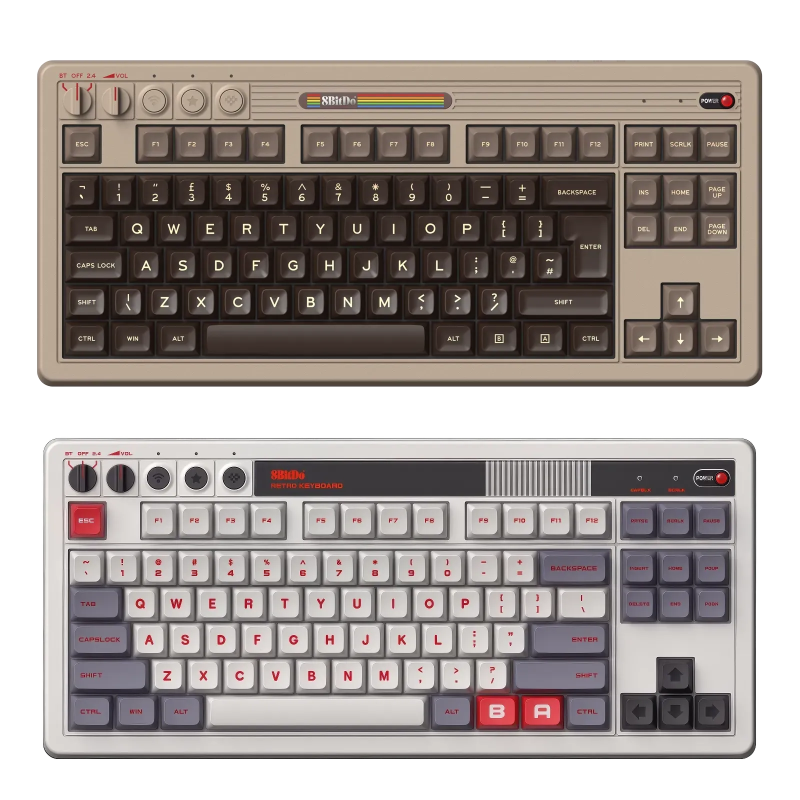
 dragonbox.de
 dragonbox.de
8BitDo Mechanische Tastatur BT/2.4G/USB kaufen | Retro-Gaming
8BitDo mechanische Retro-Tastatur mit Bluetooth, 2.4G & USB. Hot-swap, programmierbar, 200h Akku. Jetzt im Retro-Gaming-Shop bestellen!
dragonbox.de
8BitDo Retro 18 Mechanisches Numpad C64 Edition kaufen
8BitDo Retro 18 Mechanisches Numpad im C64-Design: 2-in-1 Numpad & Taschenrechner mit Kailh-Schaltern. Bluetooth, 2.4G & USB. Jetzt bestellen!
dragonbox.de
I thought the coding agents were trained on practically all public code out there in the net, and then arguably some private code some people may not realize it's training them or something.I'm also wary of the additional attack surface. As with all new technologies, security is an afterthought and I guess it won't be long before some organizations find way to poison the training data, do prompt injection on a massive scale or find another way to have it discreetly inject malware in the code or compromise the computer it's working on.
Do you think those evil organizations are going to find an even more poisonous corpus ? That'd be a big achievement in its own, if only as an existence proof.
I guess the bad actors (I mean those outside the relevant corporate boards) may find ways to trick the agents to misbehave more or more predictably, but not sure it'd be through training.
About the risks of people stopping learning. I heard a story the other day about a teacher who added some chatbot bait in an assignment. Some white text on white background telling the
composition should include some weirdly unrelated concepts. And then he found almost all students had submitted text following the bait, and he wondered they hadn't even at least read what
they sent, if they were'nt ready to write it themselves.
Then I thought: Well, I use text based mail user agents and browsers sometimes. So what if I was the student and I read the bait and humanly wrote a piece closely following the teachers instructions?
Why should I be required to disregard, or even care that some text was white on white ? Because a teacher assumes everyone does things like himself?
So the harm form LLMs is not only what they do, but what humans feel forced to do in order to adapt to widespread LLMs.
And just like with self driving accidents. The problem is not the number or the severity but what do you do with them? Even if claude wrote always good code, it wouldn't be maintainable just because
the humans left at the place wouldn't have made the initial effort to understand the problem that coding manually requires. But then that was already out the window with offshoring, staff rotations
and general mismanagement, so will it really make it any worse ?
Yeah, it seems inconceivable they even find ROI. It seems inconceivable they get environmental permits for they data centers, it feels inconceivable their suppliers get away with buying rare earths from warlods,All these companies borrowing hundreds of billions to fund data centers worries me because it seems inconceivable that they will be able to repay the loans.
it seems inconceivable societies and governments accept collectively paying infrastructure for these companies private benefits, it seems inconceivable that they win enough lawsuits about copyright, server load,
psychological distress caused, unlicensed professional advice given, crime helping and abetting, etc.
But people keep betting on it. So I interpret it more like a bet on a change from a rules based society to a more feudal society where those with deep pockets, be they humans or things, can do what they please.
Businesses can offset hefty ai costs by hiring fewer people, but I don't see how private individuals (the biggest market by far) will want to spend that much.
Individuals will be coerced, as you say yourself.
Companies maybe can't fire so many people.
Most work is not there to produce any good, it's just there to keep people busy so they don't work around the powers that be.
So if companies stop hiring people they lose their power. Even if they could keep their production or increase benefits, that's just money.
Companies without jobs get less competitive (in the limit if they manage to offload everything to an AI and fire all employees except the CEO,
then anyone can build a competing company by just offloading to the AI, and then there's the AI-CEO joke).
Companies without jobs get less political influence, fewer people to harrass and extort, fewer places to have offices in, less dogfeeding
(a la mythical Ford wanting employees to own a car).
Exactly. But not only to you. How much are email summaries worth to anyone ? How much is your work worth to others ? (specially those paying it?).How much are email summaries worth to you? I use ai mainly as a better google and suspect must people do too. But if the cost weren't negligible (free) i'd just use duck duck go.
How much more than the AI costs is your work worth if 90% of it is done by an AI bot ?
Most work wasn't really worth much already before the AI bubble. If you get the same low quality and little purpose with higher costs, then how do you make ends meet ?
So AI is unreliable, expensive, and reckless, and people are unreliable, expensive and reckless. AI can't probably get much better, only more expensive, because
in the end it learns from humans. And even if it started learning autonomously, humans wouldn't be able to judge it's any better, just like I can't tell whether an olive tree is
more clever than another olive tree, or any more clever than I am.
But most people (rightly) dislike genocide, so you have to
keep the people alive, and you'll have to incur some costs for that. You don't have to keep any AI alive and don't have to incur costs for them.
So you could at least keep employing people.
The AI doesn't have any reason to want to take over to keep itself alive either. It's just some AI owner that wants it to exist to do something for him.
But this all depends on the AI owner not having to pay all the costs of his AI, as always, so in the end is about getting others to pay for your toys and vices,
so abuse, resistence, overthrow, like so often in history...
Yes. I think they're already doing it.My fear is that big tech will start using extortion to get individuals to shell out for ai. Enshitification. I'm really scared actually.
The smallest part of it is that you go to a search engine and get AI slop without asking for it.
That'd be nice but they thought of it and entshitificated it too. You'll be killed where the current world war gets to you, but it will be by an autonomous weapon, using AI toThat will probably happen indeed. But we can always worry more about being killed in a upcoming war I guess, hopefully we'll be back on our game in 10 years or so after the bubble has burst.
navigate, read orders, select targets, aim, etc... And you and I are most likely training it right now by writing on the nets (specially I, with my walls of text
 , you just wrote a line).
Just remember humans can also love, build works of art, assemble Pyras, etc.
kuru
Hardcore Member
Commodore Callback - android flip phone

 commodore.net
Commodore Callback 8020 - Commodore
The Smart Flip with No Social Media. From $399. Learn more
commodore.net
There is a positive and realistic ai scenario. Llms mature, more compute offers diminished returns and open source models are good enough for most use cases. Anyone can download a pre-trained model for free that they can feed their dataset to and run locally on cheap inference chips. Neural networks become an implementation detail like a database or blockchain. Software engineers do not become extinct.
open source models are very little open. Even if they're as open as they can be, you can't change them because you can't retrain them because that requires huge amounts of hardware, data and power. At most you can do inference (which also requires too much hardware and power, and some data too, but less than training). But that's not allowing anyone to participate and contribute, just to use (assuming all those efficiency gains you mean, which I don't think so realistic).There is a positive and realistic ai scenario. Llms mature, more compute offers diminished returns and open source models are good enough for most use cases. Anyone can download a pre-trained model for free that they can feed their dataset to and run locally on cheap inference chips. Neural networks become an implementation detail like a database or blockchain. Software engineers do not become extinct.
For now what you get is the hardware you were using for more efficient tasks like traditional computing got more expensive because of hyperscalers hoarding chips. So you can't even do what you used to do before AI at the same cost.
Let alone do your own inference. Let alone download all the internet to train your own models.
It's like building your own web search engine. Even if ypu have crawlers, databases, full text search indexes, and any software available, you don't have the hardware, the storage and the bandwitdh, so
you're stuck with being dependent on some deep pocketed service with their ads, their censorship or whatever.
It's a power game. The richest get to play and the poor become dependent on the rich.
With propietary software you could at least dissamble or reverse engineer (never worthwhile, but it could theoretically be done because the compiled code still contained a description of the algorithm).
With neural nets you simply can't uderstand or change any details, you have to take it as it is and go from there. So they're arguably more closed than propietary software, even those they call open.

Todespreis
Member
- Joined
- Jun 16, 2021
- Messages
- 114
Fuuuuck! That looks absolutely devastating!Probably a common thing to be suppressed, but did you hear anything about the impact of Typhoon Bavi on China?
- Shenyang (Liaoning Province): The provincial capital was hit by record-breaking rainfall.
- Chengde & Kuancheng County (Hebei Province): Continuous torrential rain caused water levels on neighborhood roads to rise more than 2 meters.
- Beijing: The capital's suburban districts (specifically Miyun and Huairou) suffered flash floods that destroyed roads, cut power to dozens of villages.
- Taizhou (Zhejiang Province): Typhoon Bavi hit this city first, impacting coastal villages like Dongsha.
- Wenzhou & Yueqing (Zhejiang Province): This area got Typhoon Bavi's second landfall.
- Hangzhou & Shanghai: Typhoon Bavi caused cancellations of hundreds of flights and thousands of train trips.
- Xianfeng (Hubei Province) & Guizhou Province: This region got over 350mm of rain fall in just 12 hours; surpassing an entire month's average.
I could imagine this has a similar impact as the closing of the Hormuz strait.
View attachment 40072
Pictures like this, if happened in Europe, would be front page news.
poor peolpe. No, i did'nt hear anything about it. But our local news are full about speculations of the possible new german leader, refugees in the country and the strong far right party. Sad to say, but it seems, that catastrophes not within the EU are just not important enough to be brought to television
Djoga'Ro
moonstruck
- Joined
- Apr 3, 2016
- Messages
- 2,649
I wanna say I can do more complex things and/or with higher code quality per time. And/or I reach a bit higher for what I want to design and implement now/this iteration.It does seem like I'm doing more or working faster but actually tasks always take the same amount of overall time from start to finish.
Null
Snug
Similar threads

- Replies
- 71
- Views
- 39K


- Replies
- 104
- Views
- 32K


- Replies
- 72
- Views
- 22K